A short documentary film about our interdisciplinary "Loss of the Night" research project is now available on youtube!
The part about the Loss of the Night app starts at 14:29.
Please share it with anyone you think might be interested!
A German version of the video is also available.
Wednesday, June 25, 2014


Tuesday, May 27, 2014
Universe in a Box
I just found out about a really excellent Kickstarter project, called "Universe in a Box":
I backed them, and if you want to encourage kids in underprivileged communities worldwide to reach for the stars, maybe you'd like to back them too! Information about the project is available on the Kickstarter page, and you can read a longer post about the project by Markus Pössel here.
When I first heard the title "Universe in a Box", I wondered if it was going to be related to something that blew my mind when I was in grade 5 or so. One of my teachers brought a great big box into the class, and asked us how much we thought could fit in it. After our guesses, she claimed that it was possible to get the entire school building into the box. After we expressed our disbelief, she revealed the trick by getting someone to climb inside, and closing the lid on them. The point was that the "inside" and "outside" of the box are actually relative concepts, and if you want to enclose the entire universe, all you have to do is climb into a big enough box.
Tuesday, May 20, 2014
Aerial images of Berlin at night
It was recently asserted to me that when you look at cities from an airplane you see only lit streets, not dots corresponding to street lamps. My job often involves flying at low altitude over Berlin, and in my experience, there are massive numbers of individual lamps visible from the air. I decided to share some of the photos I've taken that show the "dots". If you're interested in pretty images of monuments from the air at night, look here instead.
The first example is what we'd like to see - the street is lit, but you don't see any dots corresponding to the lamp:

The rest of the examples show that in many places you can see street lights from the air:


Finally, here's an example of the kind of lamp that's a problem - because of the curved glass a lot of light is directly emitted into the sky:


The first example is what we'd like to see - the street is lit, but you don't see any dots corresponding to the lamp:
The rest of the examples show that in many places you can see street lights from the air:
|
Finally, here's an example of the kind of lamp that's a problem - because of the curved glass a lot of light is directly emitted into the sky:
Thursday, May 8, 2014
Possible meteor shower on May 24
Mark your calendars: May 24 is probably the best night of the year to make Loss of the Night app and Globe at Night observations. The reason? Earth is going to pass through the debris ejected by comet 209P/LINEAR in the 1800s.
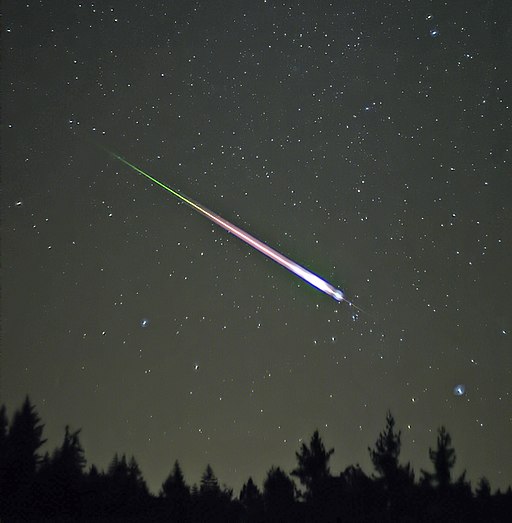
Since it's not known what the comet was doing in the 1800s, there's a lot of room for surprises. The peak is forecast between 2-4 o'clock in the morning Eastern Daylight Time (8-10 am Berlin time) on May 24th. Since there is considerable uncertainty on when exactly the peak will occur, depending on your location it may be worth going out on both May 23 (late evening), May 24 (early morning) or the early evening of May 24. Use this applet to figure out the most likely best times to observe at your location.
I have seen a number of meteors while using the app, and even once a fireball over Berlin! The next moon free phase runs from approximately May 19-28.
Lighting strategies in England
A number of English councils are experimenting with replacing dusk-till-dawn lighting with a different lighting regime, either involving dimming of lamps, or else switching them off. The Campaign to Protect Rural England has done a survey of councils to try to understand how widespread this practice is, what the councils reasons are, and to learn more about what types of strategies are being used. They've produced a 32 page report summarizing their findings that you can download for free. They've also made the short slideshow below to present the main findings:
Lighting survey results from cpre
If you found that interesting, you may also be interested in a related report submitted to the Department for Environment, Food, and Rural Affairs: A review of local authority road lighting initiatives aimed at reducing costs, carbon emissions and light pollution.
Finally, my group recently published a paper discussing recommendations that we suggest policymakers should adopt in order to reduce energy consumption, and reducing light levels during periods of little activity was one of our recommendations. The paper is unfortunately not open access, but you can download an author's copy from my personal website, Redefining efficiency for outdoor lighting.
Thursday, April 24, 2014
Lighting in Durham, NC
I'm in Durham, North Carolina for a meeting, and since I've got jet lag I was out at 3 in the morning to use the Loss of the Night app and take some photos of the street lights here for the view from your app series.
There seems to be a mix of streetlamps here with the lamps changing from one pole to the next. I annotated the photo below to show the difference in glare between poorly designed lamps and full cutoff lamps:
If you zoom in, you'll see that you can just barely see the glow from the well designed lamps. They put all of their light where it's needed, and don't send it way down the block to distract drivers! The photo below was taken by Connie Walker, and shows the kinds of poorly shielded lamps that are typical in this part of town:

I saw a lot of examples of incredibly bad parking lot lighting, and this was the worst:
The lamp is basically inside of a tree, so there is a huge area of the parking lot that's unlit. It's not a real streetlight, it's just a floodlight tipped at an angle, so that it sprays light everywhere - except on half of the parking lot! You can see that it shines directly into the house windows as well - and that someone is awake (a light is on). Maybe they have insomnia because of the glaring lamp shining in their bedroom?
I really don't understand what's going on in the next two photos. There is a really bright and poorly directed floodlight, but I'm not sure if it's supposed to be lighting the parking lot or the building facade. In the first photo, you can see that it's a really glaring light that is particularly poorly situated: right before drivers will make a left turn through a pedestrian crosswalk:
I often hear that lights are bright in the US because of fears of litigation. But couldn't a driver that hits a pedestrian blame it on the glaring floodlight and sue the business? The next photo shows how glaring the lamp is for pedestrians:
And finally the business itself. At first I assumed that this was supposed to be facade lighting, but after seeing more parking lots I think the facade lighting may be accidental:
Here is a gas station that should really be using recessed lighting. It would eliminate the glare, and leave a similar brightness at the pumps:
You can see the same kind of floodlight disaster on part of the parking lot of the station:
But right across the street is a WONDERFUL example of how parking lots should be lit! Just look at how little glare there is! The parking lot itself had extremely good visibility, and was very well lit. Of course, since the bank is closed at 3 am, it's unclear whether the lamps need to be on...
Finally, here are the glaringly white lights of our hotel parking lot. The surface brightness was probably similar to the photo above, but it was much less comfortable to walk there because of the glare:
In case anyone wants the original copy of the first image (e.g. to translate the text), here it is:
There seems to be a mix of streetlamps here with the lamps changing from one pole to the next. I annotated the photo below to show the difference in glare between poorly designed lamps and full cutoff lamps:
 |
| Streetlamps by Christopher Kyba is licensed under a Creative Commons Attribution 4.0 International License. |
I saw a lot of examples of incredibly bad parking lot lighting, and this was the worst:
 |
| Dark shadows by Christopher Kyba is licensed under a Creative Commons Attribution 4.0 International License. |
The lamp is basically inside of a tree, so there is a huge area of the parking lot that's unlit. It's not a real streetlight, it's just a floodlight tipped at an angle, so that it sprays light everywhere - except on half of the parking lot! You can see that it shines directly into the house windows as well - and that someone is awake (a light is on). Maybe they have insomnia because of the glaring lamp shining in their bedroom?
 |
| Floodlit house by Christopher Kyba is licensed under a Creative Commons Attribution 4.0 International License. |
I really don't understand what's going on in the next two photos. There is a really bright and poorly directed floodlight, but I'm not sure if it's supposed to be lighting the parking lot or the building facade. In the first photo, you can see that it's a really glaring light that is particularly poorly situated: right before drivers will make a left turn through a pedestrian crosswalk:
 |
| Turning hazard by Christopher Kyba is licensed under a Creative Commons Attribution 4.0 International License. |
I often hear that lights are bright in the US because of fears of litigation. But couldn't a driver that hits a pedestrian blame it on the glaring floodlight and sue the business? The next photo shows how glaring the lamp is for pedestrians:
 |
| Glaring lamp by Christopher Kyba is licensed under a Creative Commons Attribution 4.0 International License. |
And finally the business itself. At first I assumed that this was supposed to be facade lighting, but after seeing more parking lots I think the facade lighting may be accidental:
 |
| Lit facade by Christopher Kyba is licensed under a Creative Commons Attribution 4.0 International License. |
Here is a gas station that should really be using recessed lighting. It would eliminate the glare, and leave a similar brightness at the pumps:
 |
| Poorly lit gas station by Christopher Kyba is licensed under a Creative Commons Attribution 4.0 International License. |
You can see the same kind of floodlight disaster on part of the parking lot of the station:
 |
| Floodlit parking lot by Christopher Kyba is licensed under a Creative Commons Attribution 4.0 International License. |
But right across the street is a WONDERFUL example of how parking lots should be lit! Just look at how little glare there is! The parking lot itself had extremely good visibility, and was very well lit. Of course, since the bank is closed at 3 am, it's unclear whether the lamps need to be on...
 |
| Well lit parking lot by Christopher Kyba is licensed under a Creative Commons Attribution 4.0 International License. |
Finally, here are the glaringly white lights of our hotel parking lot. The surface brightness was probably similar to the photo above, but it was much less comfortable to walk there because of the glare:
 |
| Parking lot with glaring lamps by Christopher Kyba is licensed under a Creative Commons Attribution 4.0 International License. |
In case anyone wants the original copy of the first image (e.g. to translate the text), here it is:
 |
| Streetlights by Christopher Kyba is licensed under a Creative Commons Attribution 4.0 International License. |
Tuesday, April 22, 2014
The Loss of the Night app is 1 year old!
The Loss of the Night app went into the play store on April 22, 2013, so today is the app's first birthday!

Since that time, we started this blog, we held our first Flashmob for Science, we upgraded the app to support 11 languages, and most importantly, we've had over 11,000 observations submitted! Most of the observations were taken by people using the app under non-ideal conditions (e.g. with clouds or the moon out), but tonight we will probably reach our 1,500th observation with data that we can use for analysis!
The app's birthday means that we are going to start to have data taken at the same location in multiple years. The major scientific goal of this project to understand how the sky is changing as the world transitions to LED lamps. This is something we can't measure with the current Earth night observing satellites because they are not sensitive to the blue light that is typical of the most energy efficient LEDs. (And also because they look at the ground, not the sky!) We can only get these measurements by having people from around the world look up.
I think that 1,500 observations in the first year is a great start, but we really need your help to expand further! The more observations we have, the more accurate our measurement of the change in the night sky will be, and the more quickly we will be able to report it. So please, tell your friends and family about the app, post a link to the download site on Facebook, and the next time you have a clear night sky in your city, please go out and do a measurement!
Other ways you can help:
Thanks again to everyone who has contributed data! Without you, there would be no project!
Since that time, we started this blog, we held our first Flashmob for Science, we upgraded the app to support 11 languages, and most importantly, we've had over 11,000 observations submitted! Most of the observations were taken by people using the app under non-ideal conditions (e.g. with clouds or the moon out), but tonight we will probably reach our 1,500th observation with data that we can use for analysis!
The app's birthday means that we are going to start to have data taken at the same location in multiple years. The major scientific goal of this project to understand how the sky is changing as the world transitions to LED lamps. This is something we can't measure with the current Earth night observing satellites because they are not sensitive to the blue light that is typical of the most energy efficient LEDs. (And also because they look at the ground, not the sky!) We can only get these measurements by having people from around the world look up.
I think that 1,500 observations in the first year is a great start, but we really need your help to expand further! The more observations we have, the more accurate our measurement of the change in the night sky will be, and the more quickly we will be able to report it. So please, tell your friends and family about the app, post a link to the download site on Facebook, and the next time you have a clear night sky in your city, please go out and do a measurement!
Other ways you can help:
- We would love to hear back about your experience with the app, especially if you had any problems, or if you have recommendations for how we can improve it! Please comment here.
- We are looking for translators for future releases.
- We want photos of good and bad lighting for the view from your app series.
- We are looking for a landscape photo taken in an area with no light pollution on an overcast moonlit night.
Thanks again to everyone who has contributed data! Without you, there would be no project!
Subscribe to:
Posts (Atom)