Update: Changes have been made to the app since this post. For a more recent update list see here.
Monday, December 7, 2015


Thursday, December 3, 2015
Putting citizen science data back in the hands of citizens!
I'm very pleased to announce that our new web application for viewing skyglow data taken by citizen scientists is now online, at myskyatnight.com!
It allows you to view where data has been taken:
It lets you view individual Loss of the Night app observations:
It allows you to do trend analyses to see how skyglow is changing:
And it also allows you to access all of your own data, using the "My Measurements" tab.
It will take a few years of observations before the trend analyses start to be really useful, so go out and observe your night sky often! Bur right now, head over to myskyatnight.com, and have some fun exploring the data collected by tens of thousands of citizen scientists from around the world!
It allows you to view where data has been taken:
 |
| Skyglow observations in Europe and northern Africa |
It lets you view individual Loss of the Night app observations:
 |
| A single Loss of the Night app observing session by a citizen scientist |
It allows you to do trend analyses to see how skyglow is changing:
 |
| Trend analysis for Globe at Night data in Tucson, Arizona |
It will take a few years of observations before the trend analyses start to be really useful, so go out and observe your night sky often! Bur right now, head over to myskyatnight.com, and have some fun exploring the data collected by tens of thousands of citizen scientists from around the world!
Tuesday, November 24, 2015
Gift idea
Here's a chance to give someone a gift and do something to help conserve the night at the same time: give them an IDA t-shirt!

There are 3 different styles to choose from (the one pictured here is my favorite), and the proceeds from all three will go to support IDA's work, such as managing the International Dark Sky Places.

There are 3 different styles to choose from (the one pictured here is my favorite), and the proceeds from all three will go to support IDA's work, such as managing the International Dark Sky Places.
Monday, November 23, 2015
Submitted photos
I have some photos to share taken by friends of the blog. First, a photo of the skyglow caused by poorly shielded lamps at the Great Leighs Racecourse in Essex, United Kingdom:
Click for more dramatic photos of the skyglow and lamps.
Liz Perkin (@riverperkin on twitter) snapped this photo of lamps that don't prevent animals from getting inside:
This of course slightly reduces the light that gets to the ground, and
also greatly increases the amount of light that gets emitted into the
sky. In the worst case, lamps that let arthropods inside can get downright gross.
Lastly, a photo by Roland G. Dechesne of the Royal Astronomical Society of Canada:
 |
| Skyglow from Great Leighs Racecourse is licensed under a Creative Commons Attribution 4.0 International License. |
Liz Perkin (@riverperkin on twitter) snapped this photo of lamps that don't prevent animals from getting inside:
 |
| Spiderwebs in a lamp by Liz Perkin, originally posted on instagram |

Lastly, a photo by Roland G. Dechesne of the Royal Astronomical Society of Canada:
Patchy fog east of #Calgary accentuates the light distribution patterns of these lights pic.twitter.com/jnchAMUDLY
— Calgary RASC (@CalgaryRASC) November 10, 2015
Thursday, November 19, 2015
Moon phase calendar for 2016
Loss of the Night app user Andrew Cool from Australia has once again produced his very cool calendar of the phases of the moon in 2016:
You can download his original images in low, high or poster quality resolution on his SkippySky website. He also has a Southern Hemisphere calendar. Andrew says:
If this is your first-ever visit to the blog, welcome! The blog is about a citizen science app called "Loss of the Night". We need your help to understand how changes in street lighting technology are changing the night sky. You can read our introduction to the blog here, and instructions on how to use the app here.
There's lots more to see, including:
 |
| Northern Hemisphere moon phases, by Andrew Cool |
You can download his original images in low, high or poster quality resolution on his SkippySky website. He also has a Southern Hemisphere calendar. Andrew says:
Please feel free to download the calenders. Print them by all means, but I do ask that you play nicely and retain the discrete Copyright information in each image.
If you find that the Calendars are useful, I'd be very happy to receive a small donation via PayPal to help keep the SkippySky website and my single home PC running.
Use the PayPal buttons on the website at www.skippysky.com.au
If this is your first-ever visit to the blog, welcome! The blog is about a citizen science app called "Loss of the Night". We need your help to understand how changes in street lighting technology are changing the night sky. You can read our introduction to the blog here, and instructions on how to use the app here.
There's lots more to see, including:
- news about our "Flashmob for Science" events
- photos of how searchlights look to migrating birds
- photos of terrible street lighting from Spain
- photos of great parking lot lighting from Germany
- proof that your eyes have no idea how bright your computer screen is
Sunday, November 1, 2015
Photos of Berlin at night
On Saturday I flew over Berlin and took a number of photos. I posted them to twitter, and all of them are collected below:
If you liked the photos, please share your favorites along with this post on twitter and facebook!
Tegel airport pic.twitter.com/gosVekd5iz
— Christopher Kyba (@skyglowberlin) November 1, 2015Berlin from the North pic.twitter.com/cRQz339QUj
— Christopher Kyba (@skyglowberlin) November 1, 2015Alexanderplatz and Prenzlauer Berg pic.twitter.com/UQRN1FWwRs
— Christopher Kyba (@skyglowberlin) November 1, 2015Berlin's Siegessäule from 9500 feet up. pic.twitter.com/JYpZ6VUlqr
— Christopher Kyba (@skyglowberlin) November 1, 2015Brandenburger Tor, the Reichstag, and Potsdamer Platz through the nadir port of our aircraft. pic.twitter.com/NxOn3gn8K8
— Christopher Kyba (@skyglowberlin) November 1, 2015Funkturm, Olympiastadion, and Spandau pic.twitter.com/a7zMap1wV2
— Christopher Kyba (@skyglowberlin) November 1, 2015I think the bright orange lights are greenhouses (inside of Berlin!). I think some are part of the botanical garden. pic.twitter.com/FbuACrI2uh
— Christopher Kyba (@skyglowberlin) November 1, 2015I think the bright area in the bottom right is Stadion Wilmersdorf. By eye it looked brighter than Olympiastadion. pic.twitter.com/BomUmmbJ3J
— Christopher Kyba (@skyglowberlin) November 1, 2015Zoo, Potsdamer Platz, and Alexanderplatz. And Mitte. And Tiergarten. And much of the rest of Berlin... pic.twitter.com/EoKOOe6ABp
— Christopher Kyba (@skyglowberlin) November 1, 2015Hey Telefunken-Hochhaus on Ernst-Reuter Platz: Eat your heart out! pic.twitter.com/bTn34asgii
— Christopher Kyba (@skyglowberlin) November 1, 2015Skyglow as seen from the sky... It's really hard to photograph. Here's a similar photo: https://t.co/0XSvyfJxOb pic.twitter.com/PgFyol5TAN
— Christopher Kyba (@skyglowberlin) November 1, 2015SXF and BBI pic.twitter.com/zh6PCy0su4
— Christopher Kyba (@skyglowberlin) November 1, 2015Look at this photo of Berlin Mitte. Then look at the Fernsehturm. Can you figure out what's going on? pic.twitter.com/aUbb7qex37
— Christopher Kyba (@skyglowberlin) November 1, 2015
Reducing light pollution is really not that complicated... @IDADarkSky @IYL2015 @cities4tnight @RASC_LPA pic.twitter.com/XUScGbk5N0
— Christopher Kyba (@skyglowberlin) November 1, 2015
If you liked the photos, please share your favorites along with this post on twitter and facebook!
Check out these 15 photos of Berlin at night from 9,500 feet up! http://lossofthenight.blogspot.de/2015/11/photos-of-berlin-at-night.html
Posted by Verlust der Nacht - Loss of the Night on Sunday, November 1, 2015
Check out these 15 photos of Berlin at night from 9,500 feet up! https://t.co/j7rgDkAn61 pic.twitter.com/axOf9baRan
— Christopher Kyba (@skyglowberlin) November 2, 2015Tuesday, September 29, 2015
Europe during last night's lunar eclipse
Yesterday morning the moon passed into the Earth's shadow. The period of totality happened to occur just as the Suomi NPP satellite was passing over Europe and northern Africa. Suomi carries the Visible Infrared Imaging Radiometer Suite (VIIRS), which includes a "Day Night Band" which is the best (and only) full-Earth nighttime imaging sensor. That makes for a very pretty picture:
Blogger has limits on the image size, so you probably want to see this higher resolution version (the full resolution version is hundreds of Mb, if you want to download it you can for the next two weeks here).
When the moon is full, Suomi can see clouds and land extremely well, and oceans and lakes appear extremely dark. The brightest spots are artificial light from human settlements. For example, check out this zoom in of the Nile delta, Israel, and the Gulf of Suez from the same image:
But during the eclipse, the moonlight is temporarily gone, and the areas of Europe and northern Africa were plunged into starlight, which is just a bit too dim for good imaging from the sensor. Luckily for us, much of Europe had clear skies, meaning that we can see the city lights shining through!
Nearly a year ago I posted an image of a lunar eclipse over North America that is maybe even cooler because of the different gradient in moonlight.
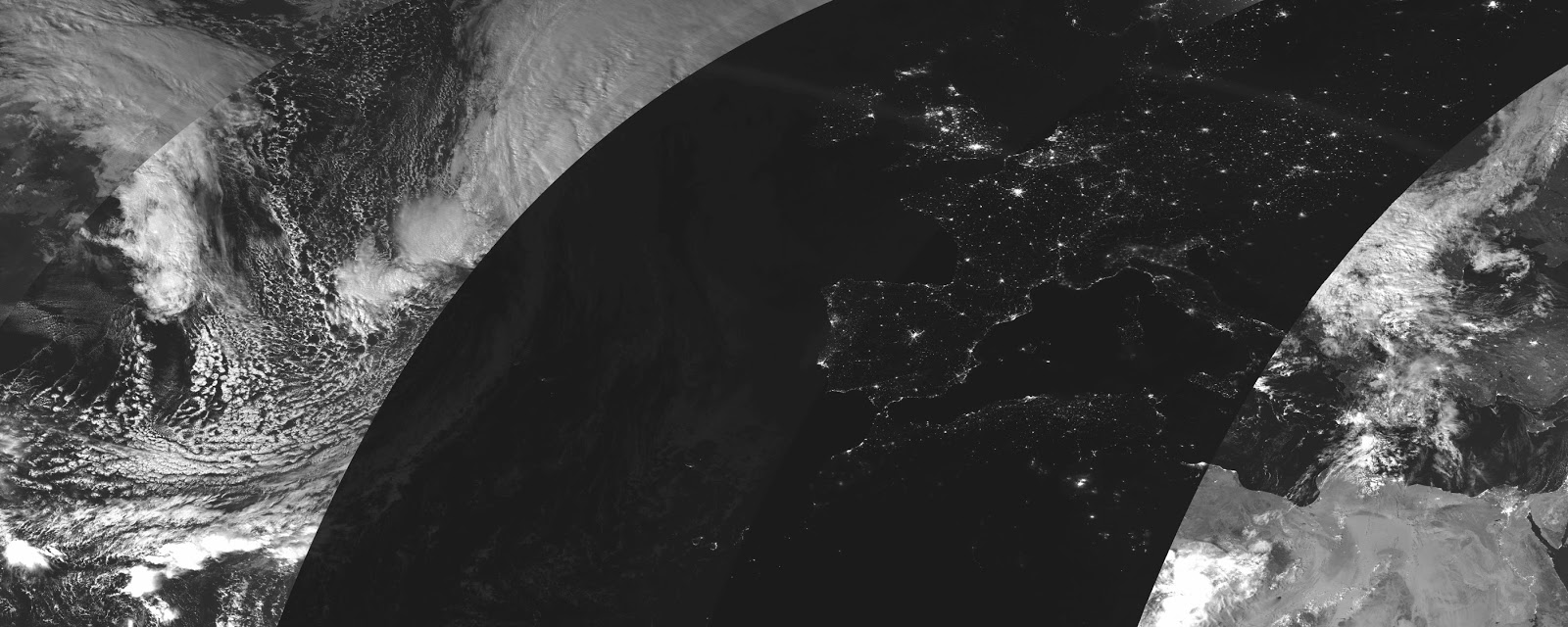 |
| Image and Data processing by NOAA's National Geophysical Data Center, cropped and enhanced by me. This image can be used with credit to NOAA and me. |
Blogger has limits on the image size, so you probably want to see this higher resolution version (the full resolution version is hundreds of Mb, if you want to download it you can for the next two weeks here).
When the moon is full, Suomi can see clouds and land extremely well, and oceans and lakes appear extremely dark. The brightest spots are artificial light from human settlements. For example, check out this zoom in of the Nile delta, Israel, and the Gulf of Suez from the same image:
 |
| Image and Data processing by NOAA's National Geophysical Data Center, cropped and enhanced by me. This image can be used with credit to NOAA and me. |
Nearly a year ago I posted an image of a lunar eclipse over North America that is maybe even cooler because of the different gradient in moonlight.
Subscribe to:
Posts (Atom)