On March 14 (Pi day) together with Clear Sky Blog we will host a "Flashmob for Science" event in Park am Gleisdreieck. You can register (and let your friends know about it) on Facebook, and you can read more about the event (in German) on this Clear Sky Blog post or from Wissenschaft im Dialog.
The idea behind our Flashmob for Science events is to understand how much variation there is between observations from different users. Everyone has slightly different eyesight, different phone displays, and a different threshold for what counts as "seeing" a star. On top of that, the order of the stars we suggest and accidental mis-identifications can affect the result (which is why viewing more than the minimum 8 stars is a good idea!). These differences aren't a problem for the science, as long as we understand how large the variation due to them is.
Our first-ever Flashmob for Science in 2012 was a relatively small affair. This time we're aiming for a much larger event. The more participants we have, the better our understanding of these variations will be! So please come and join us in Berlin on March 14!
Note: When deciding whether a star is "visible" or not, the best technique is to say it's not visible unless you can always or nearly always see it with direct vision. If it only occasionally twinkles into view, say it's invisible or that you can only see it with averted vision.
Wednesday, February 18, 2015


Thursday, February 12, 2015
Tweeted summary of our new paper about skyglow
We published a paper about skyglow today, in which researchers from 12 countries continuously measured the night sky brightness during the summers of 2011 and 2012. The paper is open access, so you can read it for free here!
Here are the highlights:
Here are the highlights:
At 7 of the sites in our new #LightPollution study, the sky was always at least 10 times brighter than a starlit sky: http://t.co/t7247Qb7sr
— Christopher Kyba (@skyglowberlin) February 12, 2015At 30 of the sites, the sky was at least twice as bright as a starlit sky at least 95% of the time: http://t.co/t7247Qb7sr
— Christopher Kyba (@skyglowberlin) February 12, 2015The relationship between typical brightness of overcast and clear skies changes at city limits http://t.co/t7247Qb7sr pic.twitter.com/xy9iUIazsx
— Christopher Kyba (@skyglowberlin) February 12, 2015Here we compare the sky brightness as the moon rises over Berlin and IDSR Westhavelland. In Berlin, the sky darkens! pic.twitter.com/g82CQ59afi
— Christopher Kyba (@skyglowberlin) February 12, 2015@skyglowberlin This is because the city gets darker as the night goes on, and Berlin's glow is so much brighter than the glow from the moon.
— Christopher Kyba (@skyglowberlin) February 12, 2015Here we compare the entire moon-free data set for 2 sites in 1 plot. NSU is how bright it is compared to a starry sky pic.twitter.com/0adxUvWl61
— Christopher Kyba (@skyglowberlin) February 12, 2015The top plot is Kitt Peak in Arizona, the bottom is near the center of Berlin.
— Christopher Kyba (@skyglowberlin) February 12, 2015In areas without artificial light, overcast nights are WAY brighter when the moon is up (1/2) http://t.co/t7247Qb7sr pic.twitter.com/MZFgAk1nsB
— Christopher Kyba (@skyglowberlin) February 12, 2015In contrast, in areas with a lot of light pollution, the moon's effect on overcast nights is almost absent (2/2) pic.twitter.com/ePxDixPbdm
— Christopher Kyba (@skyglowberlin) February 12, 2015You can read the whole article for free! It's published #openaccess at @SciReports: http://t.co/t7247Qb7sr
— Christopher Kyba (@skyglowberlin) February 12, 2015Wednesday, January 14, 2015
Brief introduction to the Loss of the Night app project
The Loss of the Night app allows citizen scientists to estimate how many stars they can see, and by extension how bright the night sky is. The goal of the project is to track changes in artificial sky brightness in urban areas over the long term (ideally many decades). The app is available for Android and iOS devices. Detailed instructions for using the app are available (Android, iOS).
The day after you've made an observation, you view the details of your observation at the My Sky at Night website. You can also use My Sky at Night to track how skyglow is changing at your location over time.
This blog posts news about the app, and is intended to allow the app users to provide feedback on how we can improve the app in the future. For example, check out this example of one participant's observations. I also do post occasionally about other topics related to artificial light at night, for example this ongoing photo series of examples of good and bad lighting, and views of the night sky.
The Loss of the Night app project is operated in co-operation with the Globe at Night project.
The day after you've made an observation, you view the details of your observation at the My Sky at Night website. You can also use My Sky at Night to track how skyglow is changing at your location over time.
This blog posts news about the app, and is intended to allow the app users to provide feedback on how we can improve the app in the future. For example, check out this example of one participant's observations. I also do post occasionally about other topics related to artificial light at night, for example this ongoing photo series of examples of good and bad lighting, and views of the night sky.
The Loss of the Night app project is operated in co-operation with the Globe at Night project.
Sunday, January 4, 2015
Top 5 posts of 2014
Here's a look back at the five most read posts from 2014:
5) New version of the Loss of the Night app - our official announcement of the release of the iOS version and the upgraded android version.
4) Lunar eclipse viewed from space - what North America looked like to a nighttime observing satellite on October 8.
3) Astrophysicist denied entry into the USA - the crazy, unfortunate story of a friend of mine. Luckily, she was eventually allowed in.
2) How to find pictures of cities at night - lots has changed since I wrote this post, I need to update it, especially to include a link to this amazing site.
1) The promise and peril of LED lighting - a post I wrote on the day the nobel prize was awarded for blue LEDs.
Thanks to everyone for reading!
5) New version of the Loss of the Night app - our official announcement of the release of the iOS version and the upgraded android version.
4) Lunar eclipse viewed from space - what North America looked like to a nighttime observing satellite on October 8.
3) Astrophysicist denied entry into the USA - the crazy, unfortunate story of a friend of mine. Luckily, she was eventually allowed in.
2) How to find pictures of cities at night - lots has changed since I wrote this post, I need to update it, especially to include a link to this amazing site.
1) The promise and peril of LED lighting - a post I wrote on the day the nobel prize was awarded for blue LEDs.
Thanks to everyone for reading!
Tuesday, December 9, 2014
Have astronauts photographed your city at night?
Back in July, I blogged about a new portal that helps you find photos of cities at night, and three related citizen science projects. I have some astounding news about the project that I just needed to share!
Citizen scientists have completed the initial classification of over 130,000 images in the Dark Skies of ISS project. This projects sorts images taken at night on the international space station as to whether the picture contains either stars, cities, the astronauts, etc, and how sharp the image is. To avoid errors, each image was categorized by multiple participants, so that's probably over half a million classifications in less than half a year!
In the Lost at Night project, citizens apply their lay knowledge of local and international geography to identify which cities are in specific photographs. Every photo is again categorized multiple times, and this has resulted in the discovery of almost 2,500 images of cities that researchers like me didn't know existed. Images from cities like San Jose (shown below), and also from places less well known to Americans and Europeans, like Chennai, Inda, or Da Nang, Vietnam.
The citiesatnight team has released a preliminary set of these photos within a Google interface so that you can easily check if your city has been photographed. Please bear in mind that this is not a final product. If you find a city that has been misclassified, they would appreciate it if you would report it to them. Believe it or not, that link contains only the cities classified by citizen scientists. The Atlas of images put together by professional scientists and enthusiasts is actually smaller in terms of number of images, and I explained the best way to use it in July.
Finally, the citiesatnight team has also released seven examples of images that were georeferenced by volunteers. In the Night Cities project, participants match locations on the image with locations on Google Maps, allowing the photos to be overlaid on top of a map. A total of 128 cities have already been georeferenced.
The citiesatnight project has been an astonishing citizen science success story. The project was put together almost entirely through volunteer time, as far as I know it hasn't received any government financing. The International Dark-Sky Association recognized its leader Alejandro Sanchez de Miguel with an award this fall. If you know of other ways in which the project could be recognized, please nominate it!
Note to journalists and researchers: citiesatnight asks that you cite this paper if you use the images in your work.
Full disclosure: Alejandro is a close friend of mine. I played a limited role in the project, mainly by providing some minor advice and lots of encouragement.
Citizen scientists have completed the initial classification of over 130,000 images in the Dark Skies of ISS project. This projects sorts images taken at night on the international space station as to whether the picture contains either stars, cities, the astronauts, etc, and how sharp the image is. To avoid errors, each image was categorized by multiple participants, so that's probably over half a million classifications in less than half a year!
In the Lost at Night project, citizens apply their lay knowledge of local and international geography to identify which cities are in specific photographs. Every photo is again categorized multiple times, and this has resulted in the discovery of almost 2,500 images of cities that researchers like me didn't know existed. Images from cities like San Jose (shown below), and also from places less well known to Americans and Europeans, like Chennai, Inda, or Da Nang, Vietnam.


 |
| San Jose from the International Space Station. High resolution image available from NASA. |

The citiesatnight team has released a preliminary set of these photos within a Google interface so that you can easily check if your city has been photographed. Please bear in mind that this is not a final product. If you find a city that has been misclassified, they would appreciate it if you would report it to them. Believe it or not, that link contains only the cities classified by citizen scientists. The Atlas of images put together by professional scientists and enthusiasts is actually smaller in terms of number of images, and I explained the best way to use it in July.
Finally, the citiesatnight team has also released seven examples of images that were georeferenced by volunteers. In the Night Cities project, participants match locations on the image with locations on Google Maps, allowing the photos to be overlaid on top of a map. A total of 128 cities have already been georeferenced.
 |
| Manhattan at night, georeferenced by citizen scientists at citiesatnight.org |
The citiesatnight project has been an astonishing citizen science success story. The project was put together almost entirely through volunteer time, as far as I know it hasn't received any government financing. The International Dark-Sky Association recognized its leader Alejandro Sanchez de Miguel with an award this fall. If you know of other ways in which the project could be recognized, please nominate it!
Note to journalists and researchers: citiesatnight asks that you cite this paper if you use the images in your work.
Full disclosure: Alejandro is a close friend of mine. I played a limited role in the project, mainly by providing some minor advice and lots of encouragement.
Monday, December 8, 2014
Greenhouses at night
Last week I posted some photos showing examples of trees that seemed to be affected by the light from nearby street lamps. There hasn't been much research into what effect (if any) street light has on trees. But when it comes to higher light levels, we do know that plants respond to the light, and use it to grow.
Some greenhouses use artificial light to extend the growing time of plants beyond what is possible with local sunlight. When greenhouses don't bother to capture and redirect scattered light back towards the plants, this can have a really profound effect on the night sky. The image below was taken by my Dutch colleague Kamiel Spoelstra:
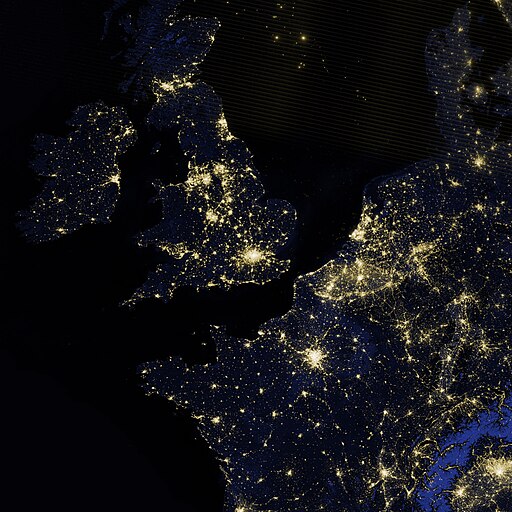
Of the places where accurate measurements of sky brightness have been reported, the brightest skies I know of are near greenhouses in the Netherlands. When you look at satellite images of the Earth at night from the new VIIRS DNB instrument, greenhouses are "blindingly" obvious, because they are tens or even hundreds of times brighter than city centers. This is part of the reason the Netherlands appears so bright - it has a lot of greenhouses!
My colleague Florian Tornow took the next two photos from a window on a recent flight to the Netherlands. The first shows a large area of greenhouses:
The second shows how bright they can be compared to the surroundings:
In some areas, greenhouse lights only turn on after midnight, because the glow from the greenhouses disturbs the nearby residents. I have heard that newly built greenhouses in the Netherlands are required to keep their artificial light in-house. With better design, instead of emitting light into the atmosphere the light can be redirected towards the plants, saving energy and reducing the impact on the nearby nighttime environment.
Update (December 10): After seeing this post, @RICE_MM shared the photo below on twitter, which was produced by Remi Boucher. It shows how a single greenhouse complex near the small town of Anson in Maine produces light roughly comparable to that of the whole city of Sherbrooke, Quebec (population ~150,000). The image also shows the area of the Mont-Mégantic International Dark-Sky Reserve.
@RICE_MM also shared this post showing the change in the area from 2010 to 2012:
Update January 29, 2018: Replaced the image of a greenhouse from the ground with a new image from Kamiel. Here is the original:
Some greenhouses use artificial light to extend the growing time of plants beyond what is possible with local sunlight. When greenhouses don't bother to capture and redirect scattered light back towards the plants, this can have a really profound effect on the night sky. The image below was taken by my Dutch colleague Kamiel Spoelstra:
 |
| Skyglow from greenhouse by Kamiel Spoelstra is licensed under a Creative Commons Attribution 4.0 International License. |
Of the places where accurate measurements of sky brightness have been reported, the brightest skies I know of are near greenhouses in the Netherlands. When you look at satellite images of the Earth at night from the new VIIRS DNB instrument, greenhouses are "blindingly" obvious, because they are tens or even hundreds of times brighter than city centers. This is part of the reason the Netherlands appears so bright - it has a lot of greenhouses!

My colleague Florian Tornow took the next two photos from a window on a recent flight to the Netherlands. The first shows a large area of greenhouses:
 |
| Greenhouse complex by Florian Tornow is licensed under a Creative Commons Attribution 4.0 International License. |
The second shows how bright they can be compared to the surroundings:
 |
| Lit greenhouses at night by Florian Tornow is licensed under a Creative Commons Attribution 4.0 International License. |
In some areas, greenhouse lights only turn on after midnight, because the glow from the greenhouses disturbs the nearby residents. I have heard that newly built greenhouses in the Netherlands are required to keep their artificial light in-house. With better design, instead of emitting light into the atmosphere the light can be redirected towards the plants, saving energy and reducing the impact on the nearby nighttime environment.
Update (December 10): After seeing this post, @RICE_MM shared the photo below on twitter, which was produced by Remi Boucher. It shows how a single greenhouse complex near the small town of Anson in Maine produces light roughly comparable to that of the whole city of Sherbrooke, Quebec (population ~150,000). The image also shows the area of the Mont-Mégantic International Dark-Sky Reserve.
 |
| Greenhouse and Sherbrooke by Remi Boucher. Image and Data processing by NOAA's National Geophysical Data Center. |
@RICE_MM also shared this post showing the change in the area from 2010 to 2012:
@rasc_lpa @skyglowberlin Check the effect of the greenhouse near Anson/Madison, Maine, not that far from our IDSR pic.twitter.com/uMO8vxI8yN
— RéserveCielEtoiléMM (@RICE_MM) December 10, 2014
Update January 29, 2018: Replaced the image of a greenhouse from the ground with a new image from Kamiel. Here is the original:
 |
| Skyglow from greenhouse by Kamiel Spoelstra is licensed under a Creative Commons Attribution 4.0 International License. |
Wednesday, December 3, 2014
Artificial light and trees
(Updated January 11, and January 16, 2015, and July 1, 2016)
Luciano Massetti, a colleague of mine from the Loss of the Night Network, recently took a series of photos in Florence that show trees near street lamps who's leaves still haven't fallen off:
At this year's Artificial Light at Night conference, Jonathan Bennie of Exeter University's Environmen and Sustainability Institute presented some intriguing data about a potential relationship between artificial light exposure and how early tree buds burst into leaves and how late leaves fall. His work, and related research by my IGB colleague Sibylle Schroer, isn't published yet, but it's starting to look like people's anecdotal observations that trees near street lamps behave differently isn't just a case of confirmation bias, it's a real phenomenon.
At this stage, there's very little information about which tree species are typically affected, or which types of lights have the strongest effect. Dr. Bennie is interested in pursuing this further, so if you've observed trees under lamps that are behaving differently than adjacent unlit trees, and if you are able to tell him the type of tree and type of lamp (e.g. high pressure sodium or LED), he'd like to hear from you. Photos of the effect are also useful, of course! You can find his contact information here.
If you liked this post, you might want to read the next one, which is about artificial light escaping from greenhouses at night. As always, if you have a photo related to artificial light that you'd like to share with the world, please send it to me along with your permission to publish it on the blog under a Creative Commons Attribution 4.0 International License as part of the "view from your app" photo series.
Update 1: @kylenano took these photos of a silver birch during the day and the night, so that you can see that it's the illuminated areas where the leaves are staying longer than they otherwise would.

Update 2: Stephen Rawlings took this time series of a brightly floodlit tree, showing how the leaves closest to the floodlight were the last to fall:
Update 3: A new paper shows that light is associated with a one week earlier budburst date in some species, and that this probably isn't an urban heat island effect (read it open access here). John Bennie has also published an open access paper about the potential effects of light on plants.
Luciano Massetti, a colleague of mine from the Loss of the Night Network, recently took a series of photos in Florence that show trees near street lamps who's leaves still haven't fallen off:
 |
| LAN leaves 2 by Luciano Massetti is licensed under a Creative Commons Attribution 4.0 International License. |
 |
| LAN leaves 10 by Luciano Massetti is licensed under a Creative Commons Attribution 4.0 International License. |
 |
| LAN leaves 15 by Luciano Massetti is licensed under a Creative Commons Attribution 4.0 International License. |
 |
| LAN leaves 22 by Luciano Massetti is licensed under a Creative Commons Attribution 4.0 International License. |
 |
| LAN leaves 28 by Luciano Massetti is licensed under a Creative Commons Attribution 4.0 International License. |
At this year's Artificial Light at Night conference, Jonathan Bennie of Exeter University's Environmen and Sustainability Institute presented some intriguing data about a potential relationship between artificial light exposure and how early tree buds burst into leaves and how late leaves fall. His work, and related research by my IGB colleague Sibylle Schroer, isn't published yet, but it's starting to look like people's anecdotal observations that trees near street lamps behave differently isn't just a case of confirmation bias, it's a real phenomenon.
At this stage, there's very little information about which tree species are typically affected, or which types of lights have the strongest effect. Dr. Bennie is interested in pursuing this further, so if you've observed trees under lamps that are behaving differently than adjacent unlit trees, and if you are able to tell him the type of tree and type of lamp (e.g. high pressure sodium or LED), he'd like to hear from you. Photos of the effect are also useful, of course! You can find his contact information here.
If you liked this post, you might want to read the next one, which is about artificial light escaping from greenhouses at night. As always, if you have a photo related to artificial light that you'd like to share with the world, please send it to me along with your permission to publish it on the blog under a Creative Commons Attribution 4.0 International License as part of the "view from your app" photo series.
Update 1: @kylenano took these photos of a silver birch during the day and the night, so that you can see that it's the illuminated areas where the leaves are staying longer than they otherwise would.
Update 2: Stephen Rawlings took this time series of a brightly floodlit tree, showing how the leaves closest to the floodlight were the last to fall:
 |
| floodlit tree by Stephen Rawlings is licensed under a Creative Commons Attribution 4.0 International License. |
Update 3: A new paper shows that light is associated with a one week earlier budburst date in some species, and that this probably isn't an urban heat island effect (read it open access here). John Bennie has also published an open access paper about the potential effects of light on plants.
Subscribe to:
Posts (Atom)